(And Somehow Hits Harder at 32 Than It Did at 18)
There’s a question they love to ask in school—one that follows you from classroom to classroom like it’s doing something important.
Where do you see yourself in five years?
At eighteen, it felt expansive. Like the future was a blank page waiting for you to scribble something bold across it. I remember exactly how I answered it. In five years, I said I’d be graduated from Western Michigan University with a Bachelor’s in Theatre, working in entertainment at Walt Disney World. There was an ease to that version of me—an assumption that if I could picture it clearly enough, life would meet me there.
No one tells you that the question doesn’t go away. It evolves—quietly, constantly—shifting shape as you do, whether you’re ready to answer it or not.
And when it comes back around in your thirties—after relationships that reshaped you, after choices you had to survive instead of celebrate—it lands with a different kind of weight. It stops being hypothetical. It becomes reflective. A quiet inventory of where you thought you’d be versus where you actually are.
Because when you’ve spent time living in the fog—whether that’s depression, grief, or just the long stretch of survival mode—the idea of five years from now can feel abstract at best and inaccessible at worst. The future stops looking like a destination and starts feeling like something just out of reach.
Still, when I was asked that question recently, I didn’t deflect.
I answered it.
Just not in the way they expect.
I gave two versions.
The Version I’m Reaching For
(Soft Light, Open Windows, and Something That Finally Feels Like Mine)
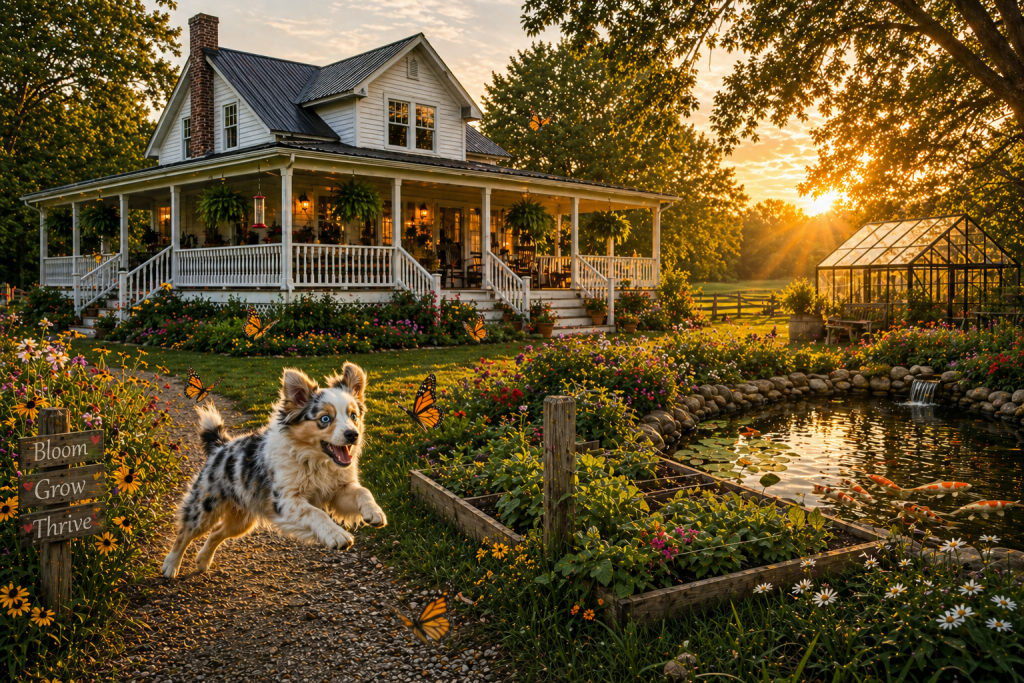
In five years, the girls and I are living in a small farmhouse set back on a few quiet acres—enough space to breathe without feeling swallowed by it.
There’s a wraparound porch that actually gets used. Not styled for photos, not curated for approval, but lived on. Morning coffee. Late-night decompression. Bare feet against wood that’s warmed by the sun. Off to one side, there’s a spot just for feeding birds—cardinals, blue jays, robins, hummingbirds—because my Grams loved them, and it feels like the kind of quiet ritual that keeps her close in a way that doesn’t hurt.
Out back, there’s a vegetable garden that leans more honest than perfect. It produces enough to feel satisfying, not enough to feel like pressure. Butterflies drift through it like they’ve claimed it as their own, moving slow and unbothered.
And there’s an Auggie—Lucia—who has made it her personal mission to chase every single one of them, darting through the yard like she’s got something to prove.
A small pond sits just far enough from the house to feel intentional, filled with koi that glide instead of rush—steady, unhurried, completely unconcerned with timelines.
There’s a barn, too. Not oversized, not for show—just solid and purposeful. Inside sits my blue 1968 Ford Mustang, finally mine in more than just daydreams, alongside the kind of “toys” that make it clear I didn’t grow up in the suburbs—a quad, a snowmobile, things meant for dirt and snow and open space.
Somewhere out back, there’s a tire swing hanging from a tree that’s seen more years than I have, and a treehouse that’s a little uneven, a little worn, and absolutely perfect in the way only something built for kids can be.
Off to the side, there’s a greenhouse that exists somewhere between function and indulgence. I use it for photoshoots—natural light filtering through glass, soft shadows settling into corners, greenery framing moments that feel almost cinematic in their stillness. Because in this version of my life, I’ve made it work. I’m supporting us through studio photography and writing—creating instead of constantly recalculating how to survive.
Inside, the house carries that same balance.
Three bedrooms. Two bathrooms. A kitchen that invites you to stay longer than necessary—spacious, slightly rustic, grounded by black and white checkered tile and filled with low-maintenance plants that somehow manage to thrive anyway. The walls hold family photos that tell the story without needing to explain it. There’s an island that becomes less of a feature and more of a gathering point, and a breakfast nook that catches the early light in a way that feels almost deliberate, turning everything warm and gold before the day fully begins.
The living room is anchored by a massive window—not decorative, but purposeful. It lets in the kind of natural light that softens everything it touches. It doubles as another photography space, another creative outlet, another reminder that I built something that sustains us.
The girls each have rooms that reflect them completely. Not coordinated. Not aesthetic for anyone else’s benefit. Just honest, evolving extensions of who they are.
My bedroom has a walk-in closet—because at this point, I’ve earned the luxury of space that’s just mine. The master bathroom feels like something out of a slower life: a clawfoot tub set beneath a skylight where the light pours in during the day and the night sky shows up when everything is quiet, and a walk-in rain shower that makes even the rushed mornings feel a little softer.
We cook together. Learn together. Explore together.
The pace is slower. The tension is quieter.
It’s peaceful in a way I didn’t know how to articulate when I was younger—but I recognize it now without hesitation.
That’s the version I reach for.
But since I don’t foresee winning the lottery—considering I don’t even play—anytime soon, I’m aware there’s another version that feels a little closer to reality.
The Version That Still Lingers
(The One Built From Pattern Recognition)
There’s another answer, too—and it doesn’t come wrapped in soft lighting or intention.
In five years, I’m still in an apartment. Or I’ve looped back to living with my mom again. Maybe it’s a trailer. Maybe it’s something that was meant to be temporary but quietly settled into permanence.
Money feels tight in a way that hums constantly beneath everything else. Not always loud enough to disrupt the day, but never quiet enough to forget. Every decision runs through the same mental filter: Can I afford this? Should I wait? What if something goes wrong?
I’m still trying to stabilize. Still telling myself that the next shift, the next opportunity, the next right move will finally create traction.
It isn’t catastrophic.
It’s just…unchanged.
And there’s something about that kind of stillness that feels heavier than chaos.
Holding Both Without Letting One Decide
What they don’t tell you when they ask that question is that sometimes the real answer isn’t singular.
Sometimes it’s layered.
It’s the life you’re actively building toward—and the one that still exists as a possibility because you’ve lived close enough to it before to know how easily it can happen.
Both versions are real. Both are informed by experience, not imagination.
The difference is where your energy goes.
Even on the days where the fog thickens and the future feels harder to access, I still have a say in the direction I move. It’s quieter than certainty and less dramatic than a breakthrough, but it’s steady.
And right now, that steadiness is enough.
Leave a Reply