
Before we get into this, a quick piece of context—because this isn’t just theory for me.
My family owns the Eaton Theatre. I grew up in it, I still work in it, and I understand firsthand what it takes to keep those doors open.
And when I lived in Traverse City, I worked at The Bay Theatre as their general manager for almost a year.
So this isn’t outsider commentary.
This is me standing in both projection booths, looking out at the same kind of screen, under two completely different systems.
🎭 Act I: The Business That Keeps the Lights On
(For-Profit — Eaton Theatre)

A for-profit theater sounds simple: sell tickets, sell popcorn, stay open.
But when you’re inside it, you realize how tight that margin actually is.
Every decision matters:
- Which films will realistically bring people in
- How to price tickets so families can still afford a night out
- When to invest in upgrades that cost more than you want to think about
Independent theaters like Eaton aren’t competing on luxury—they’re competing on loyalty. On familiarity. On the fact that people choose them over convenience.
Because streaming is easier.
Chain theaters are flashier.
And yet…people still walk through those doors.
That’s not accidental.
That’s community deciding, over and over again, that this place stays.
🫶 Act II: The Community That Refuses to Let It Die
(Nonprofit — The Bay Theatre)
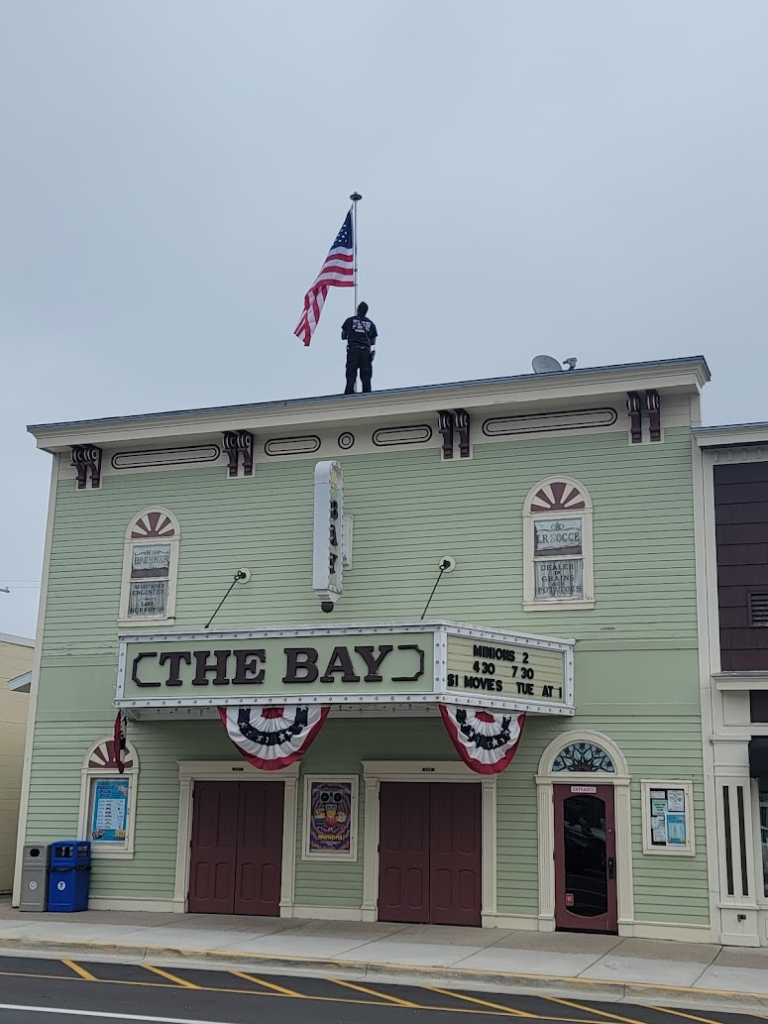
Now shift into a nonprofit model, and everything softens—but also deepens.
The Bay Theatre doesn’t exist to generate profit. It exists to serve its community.
And that changes the entire heartbeat of the building.
- Volunteers step behind the counter
- Donations are just as critical as ticket sales
- Programming expands beyond movies into experiences
When I was there, you could feel it in the smallest moments. People weren’t just customers—they were participants. Stakeholders in whether this place continued to exist.
There’s an unspoken agreement in nonprofit spaces:
We are all responsible for keeping this alive.
⚖️ Act III: The Differences You Feel Before You Understand Them
You don’t need to know the business model to notice the shift. Your body picks up on it before your brain does.
💰 Decision-Making
- For-profit: What keeps the theater sustainable and fills seats
- Nonprofit: What serves the community, even if it’s niche
🔁 Money Flow
- For-profit: Revenue supports operations and ownership
- Nonprofit: Every dollar goes right back into the theater
👥 Who’s Behind the Counter
- For-profit: Employees, schedules, payroll
- Nonprofit: Volunteers, passion, shared responsibility
🎥 Programming
- For-profit: First-run releases, broader appeal
- Nonprofit: Films, events, local culture, creative risk
🖤 Act IV: The Part That Actually Matters
Here’s what both models have in common—and it’s the part people overlook:
They’re both fragile.
One depends on steady income in an industry that’s shrinking.
The other depends on people continuing to care enough to give their time, money, and energy.
Different structures. Same truth.
If people stop showing up…they’re gone.
🎞️ Final Frame: Why This Still Matters
We treat movies like the story.
But the theater?
That’s the setting we’re all quietly protecting.
One is a story of resilience—of staying open, adapting, and proving a small business can still matter.
The other is a story of devotion—of a community deciding something is worth preserving, even when it’s not profitable.
And maybe that’s why both feel a little bit sacred.
Because they only exist if we decide they do.
Every ticket bought.
Every donation made.
Every night someone chooses the theater over the couch.
It’s all part of the same story.
And it’s still being written.
Leave a Reply