
Opera, Legacy, and the Bloodline of a Song
Mary was born in Italy around the mid-1800s—fair-haired, fiery, and destined to stand out. She came of age during Italy’s golden age of opera, when Verdi’s music filled every street and women with strong voices were both adored and judged. Somewhere in that swirl of romance and rebellion, Mary found her own stage.
She became an opera singer in Rome, likely performing at Teatro Argentina, one of the city’s oldest theaters. Her photo (below)—taken at 25 in an opera gown—shows a woman entirely in her element, elegant yet defiant.
The Matriarch’s Stage
Mary first married Professor Angelo, a scholar from Gualtieri, Italy. Their daughter, Lucia, was born there, and it’s likely Mary herself was, too. Even after Lucia’s birth, Mary continued performing—a rare act of independence for a woman of her time.
Eventually, Mary and the Professor separated. Divorce was illegal in Italy then, making her decision almost unthinkable. Still, she later married Dr. Angelo (yeah, we had a lot of Angelos), and together they had a son, Anthony, born in Messina, Sicily in 1886. Whether she followed the doctor for his work or her music brought her there, we’ll never know. What we do know is that he and their son eventually left for America, and a few years later, Lucia journeyed there with her step-father—perhaps after Mary’s passing.
The Final Curtain
Mary likely died there sometime before 1902, her voice fading from the stage long before her children crossed the ocean.
But Lucia never forgot her. On the back of Mary’s photo, she wrote:
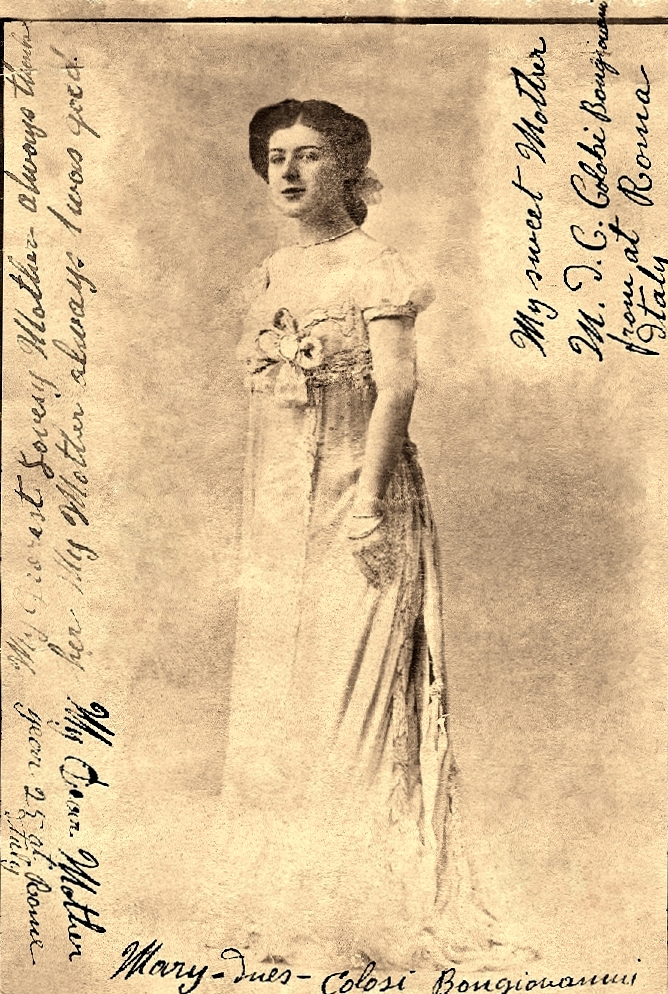
“My Dearest Lovely Mother always think her (or thank her). My mother always was good.”
Maybe that’s fitting. Some people live to be remembered; others live to resonate. Mary, it seems, did both.
This is as far back as I’ve been able to trace—for now. I requested her birth certificate in hopes of building the tree even further, but never heard back. Some stories just take their time being found.
Leave a Reply